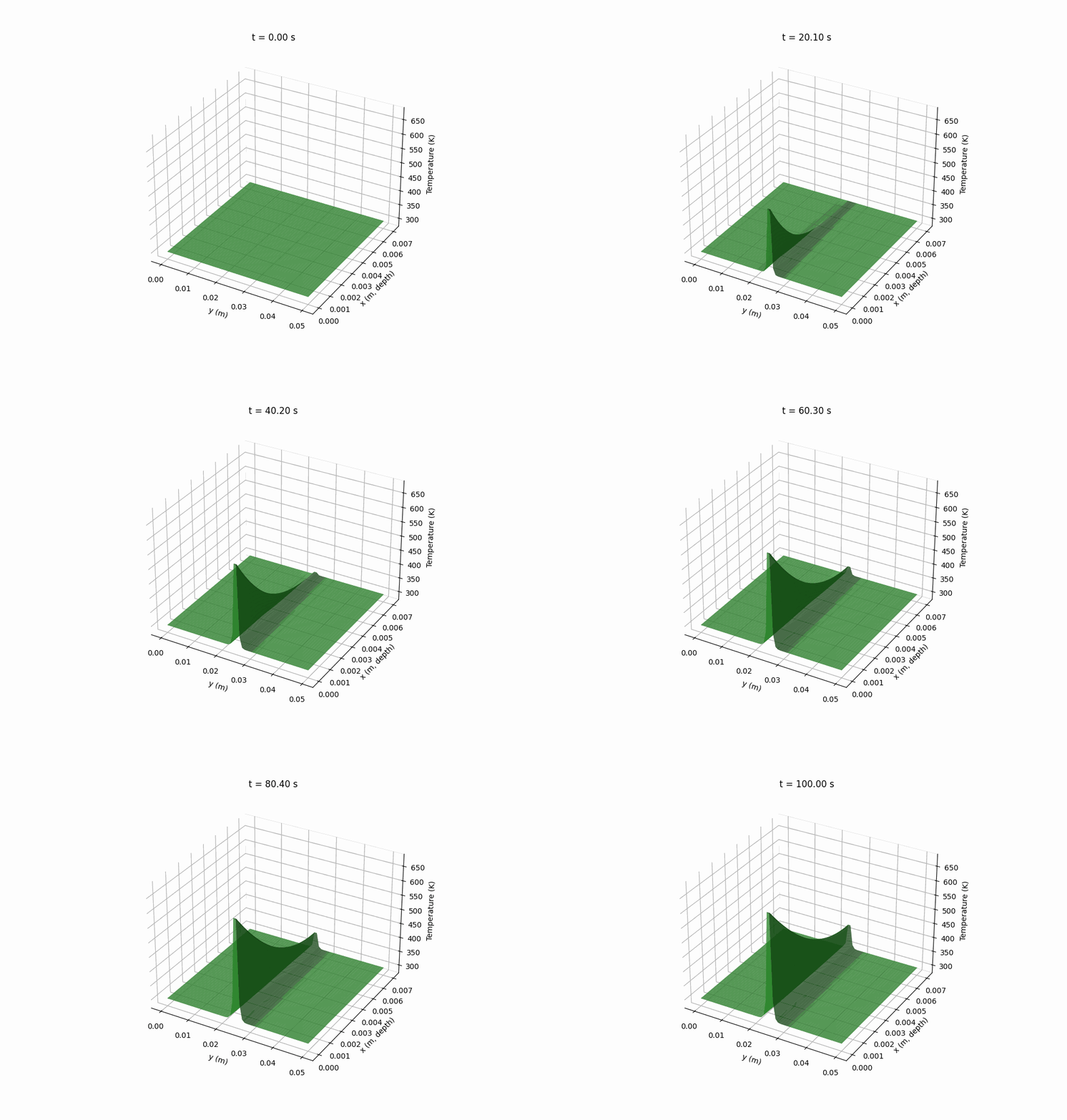
2D Heat Transfer Visualization
Measured data are used to calibrate key parameters in the PDE model. The full run lasts ~100 s, and ignition occurs near ~90 s under the selected material conditions.
Projects
A representative example of how we turn math & physics into intuitive, visual learning.
Measured data are used to calibrate key parameters in the PDE model. The full run lasts ~100 s, and ignition occurs near ~90 s under the selected material conditions.
SemiSimTech is organized from foundation to engineering application: Physics → Devices → Systems → Modeling → Reliability.
Build intuition from wave behavior, carrier effects, and material response before moving into devices. Good starting topics include calculus, RLC transients, optical mode behavior, and plasma-dispersion intuition.
Focus on photonic and semiconductor building blocks such as edge couplers, phase shifters, modulators, photodiodes, APDs, and device-level transport behavior.
Connect device behavior to link-level consequences such as PAM4 margin, BER sensitivity, optical loss budget, and transmitter / receiver tradeoffs.
Turn measured data into compact intuition models, parameter sensitivities, and engineering tradeoff views. This is where SemiSimTech becomes especially useful for practicing engineers.
Start here for intuition-building and core concept exploration.
A step-by-step interactive page that turns derivatives and integrals into visual stories. The full interactive lab is planned as part of the members library.
A clean simulator-style exploration of RLC transient response, resonance, and damping. The full interactive version is planned for members.
Build deep intuition for shell scripting using real engineering patterns: shebang, path safety (SCRIPT_DIR), command substitution, quoting, and argument handling. This lab shows how simple scripts evolve into reliable CLI tools used in real workflows.
Build systematic intuition for common Linux commands by command intent: system information, file navigation, search, mounting, and safe system control. This lab converts command lists into a structured engineering reference.
Build intuition for Python fundamentals using a structured memory-map approach: variables, operators, flow control, data structures, functions, exceptions, file operations, modules, and object-oriented thinking.
Build system-level intuition for Python as an engineering tool: data acquisition, data transformation, visualization, and modeling. This lab shows how Python evolves from simple scripts into reusable engineering pipelines.
Foundational effects that explain why devices behave the way they do.
Build intuition for choosing the correct conservation law in collision problems. This lab explains why energy and linear momentum fail for a projectile sticking to a pivoted rod, while angular momentum about the pivot is conserved.
Explore how carrier injection changes refractive index and loss in silicon-based photonic structures. This planned lab will connect directly to phase shifters, modulators, and VOA behavior.
Build intuition for how geometry, index contrast, and wavelength shape optical confinement, effective index, and field overlap in integrated photonics.
Component-level intuition labs for photonics and semiconductor devices.
Build intuition for how LDMOS devices are engineered to meet a target operating-voltage window while balancing breakdown, on-resistance, capacitance, and reliability. Includes a visual sandbox and decision framework.
Build intuition for waveguide geometry, mode confinement, effective index, and propagation loss. This lab serves as the physical foundation for modulators, photodiodes, edge couplers, and thermal tuning behavior in silicon photonics.
Explore the key tradeoff between efficiency, bandwidth, and loss in optical modulators. Build intuition for how overlap, device length, effective gap, capacitance, and drive strength impact Si MZM, LN MZM, and Ge EAM behavior.
This preview introduces a SiPho intuition project. Membership unlocks the full interactive demo and the next project in this series.
Build intuition for how carrier injection, spectral response, and forward-bias loss shape phase shifter and VOA behavior. The full interactive lab is planned for the members library.
Explore dark current, responsivity, and avalanche gain using extracted measured data and compact fit models. The full interactive lab is planned for members.
Explore how current and voltage redistribute between the channel and the drift region. The full interactive explorer is planned as a members lab.
System-level labs that connect component behavior to link performance and engineering decisions.
Connect modulator, link loss, equalization, and receiver sensitivity into one system-level intuition lab. This lab is aimed at understanding how device-level penalties propagate into BER and operating margin.
Build intuition for how integrated capacitors interact with substrate noise, leakage, and terminal biasing. This lab explains why "just a capacitor" can become a system-level failure in mixed-signal and power ICs.
A planned lab to build visual understanding of eye closure, linearity, bandwidth limits, and noise penalties in high-speed optical links.
Measured data, compact intuition models, and parameter-tradeoff thinking.
Build intuition for multi-domain co-simulation: solver coupling, interface contracts, electrical / photonic / thermal interaction, convergence, automation, validation, and systematic debugging. The lab focuses on generic, reusable engineering techniques.
Explore how electromagnetic fields distribute across layered materials and how field participation influences RF loss and sensitivity. More interactive experiments will be added to the members library.
A planned lab focused on how to turn measured curves into compact engineering models, with parameter sensitivity, autofit workflows, and physical interpretation.
A member-only lab on how multi-factor decision spaces can be formalized using utility functions, penalty terms, and tradeoff geometry. The residential example is used only as a concrete vehicle for explaining broader modeling ideas such as weighting, Pareto thinking, and explainable ranking.
Real-world stress mechanisms and why edge cases often dominate failure risk.
A diffusion-based simulator to show why edge regions can dominate humidity-stress risk under HAST-like conditions. The full simulator is planned for members.